



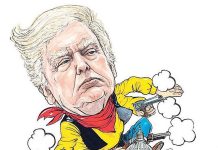



I have now reached the United States where, while waiting patiently my turn to go through a long line of immigration, I could watch another logomachy between the Republican Party contenders as candidates to the United States Presidency. I will not make any comments about the quality of the interventions but it is a parody of the first televised debate that took place in 1960 between Kennedy and Nixon.
This took my mind back to Greece and our version of debates which put me to reflect on our latest debate and their formats.
It is well known in communication that the simpler the message the more chances of its contents being understood. In my simple mind, the purpose of a political debate should be not only the differentiation of positions but also the common ground. This means that if two political chiefs are debating they should at least clear out what they feel they have in common with their adversary and then go and expand on their differences. In this manner the people can be confronted with a tangible alternative and a choice can be made. Unfortunately the skill in modern debating is more a question in creating doubt rather than outlining clear lines.
Well, let us examine the first debate and its formatting. Seven debaters and seven journalists. In terms of possible exchanges between all the participants it makes 720 possible permutations which is demential even at the level of a simple computer let alone the brilliant but nevertheless human Greek mind. But what struck me most is that each candidate received a different question from a different journalist. Not only was there a competition between party leaders but a competition between the journalists, as to who would be the best. This exceptionally complex format led to several infractions of the rules not only in excessive time in the intervention but actual interference between some journalists and the candidates. The anchorman or referee had a very difficult time but I must say he did a good job to keep most of the volcanic fumes in their bottles. Nevertheless I imagine that the Greek people that had the patience of watching the whole debate must have been confused by the diversity and number of messages, which after a week must have been reduced to very simple impressions of who had performed better and in particular if their favorite had done well by their own criteria.
I myself beyond certain generalities would be incapable of remembering much of the debate except that each one vanted his church at the expense of the other. Alexis Tsipras quite discountenanced by so many attacks coming even from former friends looked quite ill at ease and repeated his litany of new vs old, valiant fighting for the country and his perceived many social changes. Mrs. Genimatta deftly compared her party to a house with a family of old adult and young. Mr. Theodorakis emphasized the need for practical reforms while Mr. Koutsoumbas and Mr. Lafazanis talking in the same antiquated communist terminology were wasting their time and the audience’s explaining why they were different. The ebullient Panos did not break the chair or the table but subserviently supported his collaboration with his master. Mr Meimarakis, more than any, advocated a government of cooperation.
However one party was absent Golden Dawn. It may be easy to have disregard for this group that reminds us of a sad page in recent history, but why then ignore the massive atrocities of Stalin and Mao. These people however their values may be despised should be seen and interrogated publicly so that they cannot move secretly in society and foster discontent.
But I come now to what should have been the “plat de resistance”, the ingredients they were going to help us to help what is left of our conscience, i.e. the moral part of our mind what is good for Greece.
Instead of formatting this debate into a free fight where our candidates would confront each other with their solutions to our problems, they were trapped into a tussle of answers to often irrelevant questions. Of course the designers of the debate kept seven original questioners of the first debate for two protagonists and they were as eager to shine as the victims of their questions. It was as if the two wrestlers were separated by a wall made of narrowly spaced bars. Instead of hitting each other with elegant movements, they could only narrowly and imperfectly hit their opponent when he was near the bars. The result was a set of petty exchanges that did not leave any substantial impression. It was noticeable that Alexis free to recite repeatedly his litany of justice democracy and clean and new looked less stressed than in the first debate but he did not invent anything new.
And now we come to the vote which hopefully should produce a government for the next 4 years but will it? We are saddled with a long menu of reforms demanded by our creditors. This is probably a blessing because no government on its own, of whatever faction could ever legislate such reforms. The answer to the choice is which leader with which coalition will be best able to implement the reforms, negotiate some modifications and also achieve additional reforms not contemplated in the memorandum such as total simplification of the legal system and of the bureaucracy. Which government will best bring the right conditions for investment confidence?
We will know the choice of the Greek People by Sunday night and Koumoundouros wishes everyone a rime of calm reflection before dropping their envelope in the urn.