







It has been said that under the right circumstances, a single act like the butterfly flapping its wings can cause a typhoon.
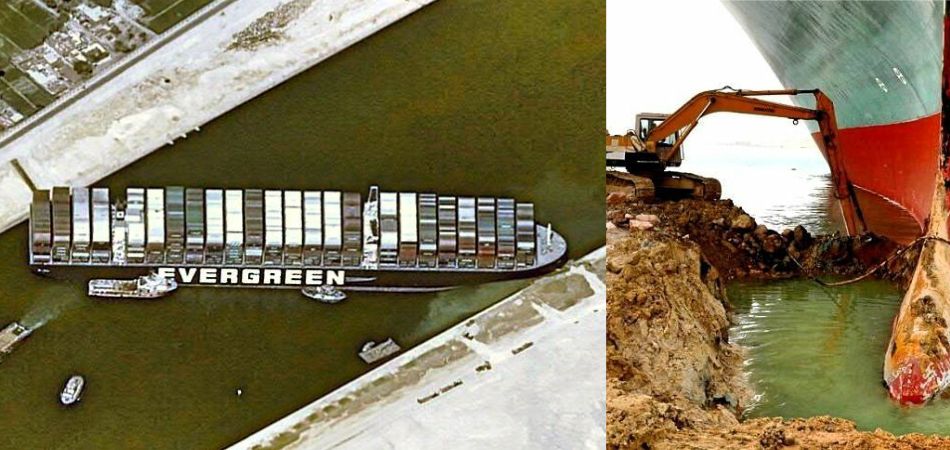
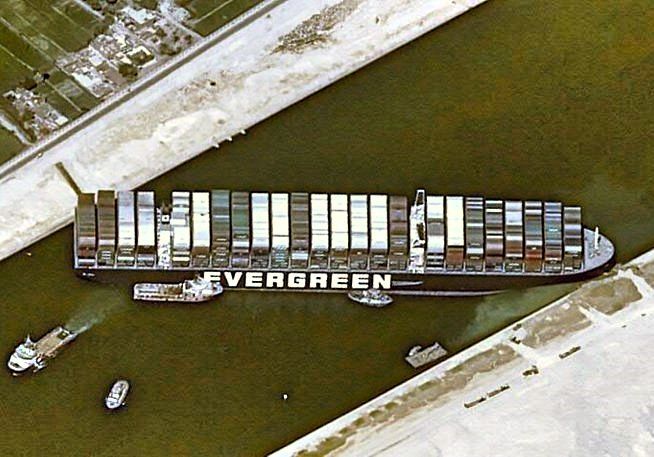
This of course is an image to convey that small things can have non-linear impacts on complex systems. As we write a humongous container ship capable of carrying some 20,000 containers has as a result of strong winds drifted sideways while navigating through the relatively narrow channel of the Suez Canal. This ship of 400 meters length and with is containers some 30 odd meters over the water act like a gigantic sail when the wind is flowing sideways. The least shift in the direction of the ship can induce in such circumstances a complete lateral flip. This what appears to have occurred last Tuesday when the “Ever Given” suddenly veered to starboard (the right) and its protruding bulbous bow impaled itself on the banks of the channel.
Like a compass arm, the ship stern continued its path and hit the other side of the channel thus blocking the whole channel and creating a build up in the vessels trying to cross through the Canal. How long and how the ship will be freed by making her lighter and be towed away cold fill several pages and the next days or weeks would fill quite a few pages.
As time passes more ships will arrive and even when traffic resumes, there will be huge delays in the arrival of the ships and their goods. What would be a serious nuisance in normal times may prove, especially if the salvage takes weeks, an additional spanner in the wheel clogs of international trade in general and the container trade in particular. For over a year we have lived with Covid and the economic activity has been constrained by the isolating measures such as social distancing. This slowdown has affected considerably the sourcing, the production, and the distribution of consumer goods. Some of us who are used to quick on-line prompted deliveries have noticed several weeks or even months delays for consumer products. Somehow the seamless chain capable of delivering products at a moments notice has slowed down. This conveying belt had been made possible by an efficient intermodal transportation through containerization, a process that revolutionized only sea transport and also facilitated the transport of goods on land. Instead of bringing cates and loading/discharging them one by one in ports, the goods would arrive prepacked in large containers of standard size that could be quickly loaded on ships that would spend very small time in ports whether loading or discharging. The containers in turn would reach their destination sing trucks or rail and be discharged at which point the empty container would be brought to an exporter who would load it and send it across the oceans. As volumes swelled, the ship sizes increased, and the ports became more efficient, reducing the transport costs, depending on the type of goods, by a factor between 10-20. This in turn facilitated the globalisation of production to the cheapest centers and in turn multiplied trade and transportation by sea. Countries with cheap labor, in particular China became the factories of the world while the western developed countries became the supermarkets relinquishing their productive capabilities.
This magnificent system invented by Malcom McLean was refined bringing just in time delivery for components of sophisticated machinery. The movement of containers was monitored and controlled by computers so that they would spend a minimum of time on shore. As the ship fleet size increased so did the container numbers. However, over time with the more efficient container turn around, the number of containers increased less than the fleet overall capacity. Whereas in the seventies, in the early days of containerisation it was thought prudent to have 3 containers per nit ship capacity, the standard became 2 to 1 and today it has drifted below 2. While before Covid the system worked like a Swiss clock, with Covid the system has come down to a crawl as Covid has slowed down considerably the movement of containers ashore and even the port operations. The result is a physical shortage of containers that has slowed down the movement of ships as they have to wait for containers. This in turn has resulted in a shortage of ships available in many parts of the world. The “Box rate” the freight charged by the liner companies has multiplied b a factor of 4 in most rotes as importers scramble for bookings. The whole process, as a result of the switch of spending from services to consumer goods has been further been destabilized by a surge in imports for consumer goods. The availability of goods is now delayed by several months and the prices have increased.
A grounding of a ship is a relatively frequent occurrence and escapes the international media but should it occur in a critical sea passage such as a busy canal, it can generate serious disturbances in the flow of trade. Past closures of the Suez Canal during Arab-Israeli conflicts resulted in temporary shortages of commodities and products particularly of oil as ships had to deviate sing a much longer route around the cape of Good Hope Today thanks to the “Sumed”, a shore pipeline linking the Red Sea and the Mediterranean Sea the Canal is no longer critical to the movement of oil although some small ships still carry some of the European requirements. The problem, today, is the flow of container ships and their precious cargoes destined to the European and the US East Coast ports. Almost 2% of the container fleet is immobilized in the Canal and each day the proportion increases.
The world is watching with a mixture of curiosity and concern at the efforts of refloating the vessel. The expectations vary from days to weeks depending on whether the ship will be able to be refloated with the help of a high tide, successful dredging in the vicinity of the ship and other means of lightering it sch as removing fuel. If unsuccessful, some of its containers would have to be removed either by large cranes or special helicopters. Not only would this take days, but it would be at least a week to bring the equipment alongside. By Monday 29th of March, we should know whether this grounding has jammed the Canal for a single or several weeks.
Whatever the case, it is clear that the problems associated with the supply chain congestion and delays stemming from the pandemic will be proportionately exacerbated. The container scarcity will be aggravated, and this will further burden the supply chain worldwide. So, one can expect higher prices and more delays. The power of the butterfly wing flap can indeed induce strong ripples in a complex system such as the supply chain.
By Digenis
30 March 2021
Read Also: The Fog of Fake News