







A lot of ink has been spilt in articles over the benefits and nuisance of mass media in politics to the point that critics blame their uncontrolled use for destroying the democratic process. The chain of social media messages that led to the insurrection of the 6th of January are proof that the nefarious use of such media can not only derail elections but, can also degenerate in political instability.

Whereas strong democracies can recover from such blows, others somber into openly totalitarian dictatures or veiled ones masquerading as democracies. Populism and its road to dictatorships are not new and the past century witnessed the worse horrors when the fires of populism were left to rage and turned into dictatorial or one-party regimes. The approach was the same as that used sometimes today, but instead of being called mass media it was known as propaganda.
Whom should we consult, but the master of them all: Adolf Hitler! We have summarized some extracts from his bible “Mein Kampf”. Some of the expressions are close to his original text while others have been rephrased for the sake of succinctness.
- Propaganda must appeal solely to the less educated masses.
- No scientific training, but moving the importance of facts, events, necessities, in the minds of masses.
- Concentrate on the validity of a fact and the necessity of an event with the objective that the necessity makes it right.
- Message must be formatted to be understood to the lowest complexity so as to be understood by the greatest mass possible
- Avoid science repeat as infinitum simple ideas.
- Propaganda should be limited to very few points that can be turned into slogans.
- Whatever the size of the lie there must be a factor of credibility.
- The great mass of people are child-like human beings who are “as undecided as they are inclined towards doubt and uncertainty.”
- They are not consciously or intentionally bad, but they use little lies to survive making them targetable for bigger lies. However, “whatever the size of the lie there must be a factor of credibility”.
- There should be no nuances in one’s statement as any concession of weakness to the other side will destroy the strength of one’s argument.
- People in an overwhelming majority are so feminine in their nature that their activities and thoughts are more motivated by feelings and sentiment than cool thought.
- This sentiment is very basic, being either positive or negative: love or hate, right or wrong, truth or lie, but never in between.
- Propaganda must confine itself to a narrow message and repeated eternally even when expressed through different media.
We are not sure that Donald Trump ever read Mein Kampf, but judging from his simplistic messages, his repeated lies, his slogans and the theatrics of his rallies, he must have been coached in this mind-bending systemic approach. Of course, with the advent of the internet, the giant data bases widespread mass media and TV the panoply has increased the panoply, but the methodology of propaganda remains the same.
What is interesting is that just as Hitler believed, science had to be excluded from messaging as it could offer truthful landmarks that could derail the impact of deformed reality or plain exaggerations. Also, the messages had to be simple and be understood by reasonably low IQ individuals that could be comforted by signals that reflected their frustrations and solutions which relieved their anxieties. We reproduce a normal distribution IQ curve.
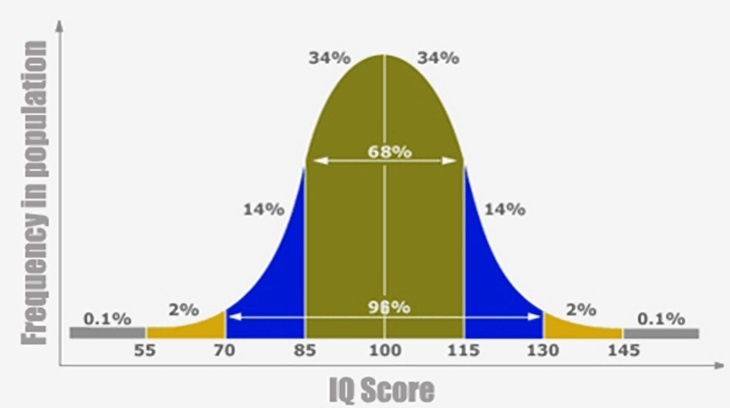
Interestingly, the largest area under the curve represents 68% of the population equally divided between the 100 mark the average IQ score. This means that in the main tranche 34% of the population has a below average intelligence. Looking at the distribution of people having a college degree one can see that the curve is almost entirely skewed in the above average area.
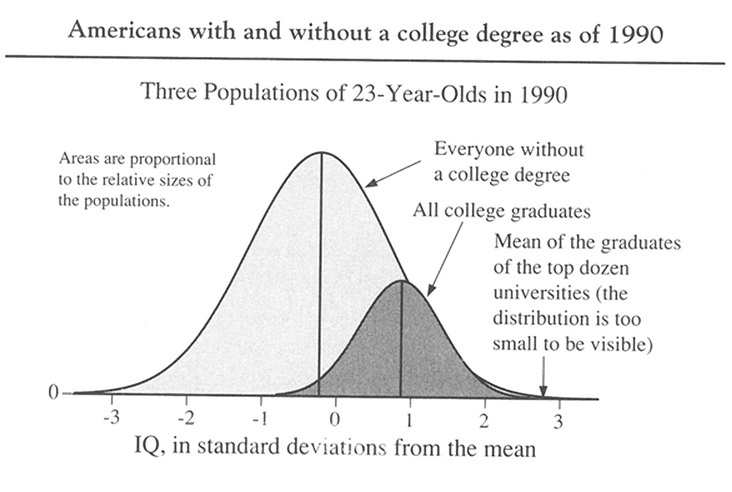
Although the figures are of 1990, there is little reason to think that a contemporary curve would be markedly different. It is therefore although simplistic easy to conclude that most people on the first tranche of 34% are less educated and form the core part of Trump supporters. The influence of targeted messaging through the mass media was much more subtle and was relying on psychological profile of micro groups in specific areas.
Before we delve in the targeting mechanics, it is worth spending some time on psychology. While pogroms were in full swing in 1942, Abraham Maslow, probably unaware of the atrocious fate of his co-religionaries, was building his theory of needs and the development of personality. Originally drawn as a series of overlaying curves over a timeline, they were meant to pictorially describe the progressive evolution of needs of an individual at each state of development from his survival needs, to his full blossoming, into a fully self-motivated personality.
Today, psychologists represent his hierarchy of needs as Pyramid. However, in his theory an individual, due to circumstances, can regress in the hierarchy, but never loses all his psychological make up in each of the needs (see blue line). The individual has regressed, and his dominant need is “esteem”, but he has retained elements of “self-actualization” that he will recoup faster when he has re-fulfilled his “esteem” needs.
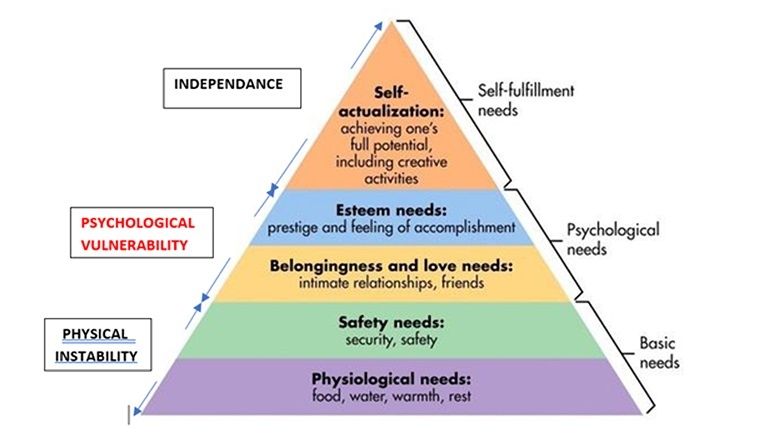
We have used this Pyramid to identify the characteritics of those needs. At the bottom of the Pyramid, the Physical Instability Group are people with serious problems and are unlikely to be malleable by social media. On the top of the Pyramid, the people have usually achieved intellectual and emotional independence and are unlikely to be swayed by naïve messages, just as somebody that is fully fulfilled. It is the intermediate “Psychological Vulnerability” group that has a herd belonging need and a desire for recognition that present an intterest for psephologists and vote seekers. This would be targets on which mass media could zero with custom made messages formatted to suit a subgroup within those categories.
The next step is to format effectively the message to a given sub group in a specific geographic area. It is here that technology and information processing is light years of the time of mass endoctcrination that became prevalent during the second quarter of the last century. Rather than messages addressed to large masses, one can, today, construct custom made messages addressed to particular clusters of individuals within a relatively small area.
Traditionally, in politics, drumming up the enthusiasm was the solution to maximize the participation of one’s political camp and hope to do a better job than the opposition. As time went by and the differences in policies between parties diminished, it was observed that elections were won by the shift of undecided voters to one side or another. It was found that raising anxiety on relevant issues was a mean to persuade undecided voters. It was this aspect that electoral consulting firms in particular Cambridge Analytica zeroed in, playing through targeted messages on voter’s emotions particularly on the negative side.
The psychologists on their part have expanded the panoply of emotions to a degree that it is becoming impossible for a non professional to establish links between them. The most logical tabulation that we were able to find is that of Robert Plutchik’s Wheel of Emotions which, at least contrasts on opposite axes the different emotions.
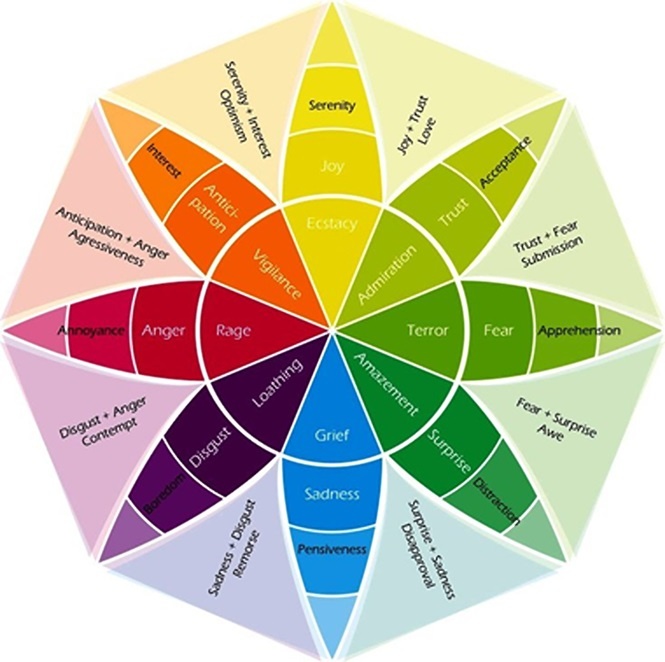
Robert Plutchik’s Wheel of Emotions
We however have a lot of reservations about the wild aggregation of so called emotions which leads to confusion. Emotions are complex physiological reactions involving a chain of chemical reactions causing our brain to release hormones and chemicals, which send us into a state of arousal. All emotions come about in this way, whether positive or negative.
As was shown by the MIT study, negative information attracts more attention as they elicit stronger and more sustained physiological reactions than positive messages. In addition, they offer journalists that yearn for easy material to project failure and negativism. As other studies have shown that adults naturally display a negativity bias, or have a predisposition to favor, learn from, and use negative information far more than positive communication, we should concentrate on the negative emotional aspects. In our modest opinion we should look at nature to understand the process of emotion.
When there is a difference of pressure between two geographic locations, a wind arises that can generate tempests on the sea or storms on land. The pressure difference is the stimulus, the wind is the motion and the level of waves is the state as a result of the motion. Conversely in humans and to a more limited degree in animals, an external stimulus (viewing an injustice) generates an emotion (anger) which translate into state (compassion). We give a few examples below to illustrate better this analogy.
- Fear felt around attending an interview for a new job causing a state of anxiety.
- Rage at being caught up in traffic casing a state of anger.
- Grief at experiencing a break-up resulting in a state of sadness or despair.
- Frustration at a partner’s investment failure causing a state of resentment.
- Rage at not being able to stick to a new workout regime leading to a state of depression.
In addition to establishing trust in a candidate or distrust in his opponents, a persuasive message should be tailored to the psychological profile of the receiver i.e. inserting elements of fear for a person known for his neurotic penchant, or addressing elements of issue and concerns or encouraging a loner to meet in groups. The category of people that are addressed are those in the 3rd and 4th groups in the Maslow Pyramid: those that need belonging and in need of love and those seeking self esteem.
It would be too long to go into a detailed analysis of the psychometric microtargeting techniques used by Cambridge Analytica and other psephology engineers. They are not very different from those used during the Nazi period. The essence is to establish a blind trust in a leader, instill a permanent state of anxiety, fear and resentment against certain groups or policies of opposed parties. This is achieved by repeated messages that fuel emotions of fright, rage, loathing and other emotions such as envy or sense of injustice all dressed by rosy solutions from the great leader.
The problem for the US today is that large groups within the Republican party have been so successfully radicalised that they still believe in the “Big Lie” i.e. that the election have been stolen, messages of healing will be derailed by Republican politicians that are blinded by their fear of loosing re-election in 2022. There is already a fissure in the Republican party, exemplified by the differences between the majority senate leader Mitch McConnell and other senators hesitant to distance themselves from Trump but to regroup it to its former values, a reverse mass media campaign will be required to achieve deradicalization. It is your “pitch”, Mitch.
By Digenis
25 February 2021
Read also: The Big Cut