







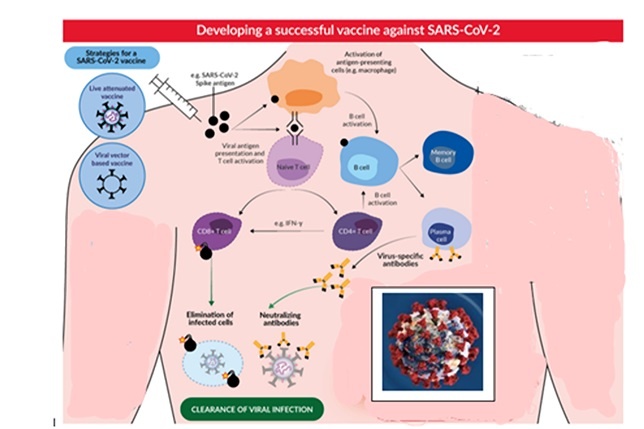
The drawing above illustrates the mechanisms of immune reaction following the administering of a SARS-CoV-2 vaccine. Among all structural proteins of SARS-CoV, S protein (in red in window) is the main antigenic component that is responsible for inducing host immune responses, neutralizing antibodies, and/or protective immunity against virus infection. S protein has therefore been selected as an important target for vaccine and anti-viral development.
CLASSICAL APPROACHES: THE ATTENUATED OR INACTIVATED VIRUS VACCINE
The traditional way of developing a vaccine has been to grow and inject patients with either live attenuated (measles, mumps, rubella, smallpox, and chickenpox). or inactivated dead viruses (flu, hepatitis A and rabies). These vaccines prompt an immune response without causing disease but prompt the immune system to build up the adaptive system’s weaponry to fight off that virus should it be encountered in the future.
Live(attenuated) Vaccines
This approach has been regularly used recently for developing seasonal flu vaccines. The virus is weakened by altering its genetic code to reduce the offensiveness of its viral proteins. It is known as viral deoptimization and enables the synthesis of engineered live-attenuated vaccines. Starting with only the digital sequence of the viral genome, one of the virus’ proteins DNA is digitally reconstituted and the various DNA combinants (cDNA) can be reassembled to form an attenuated live virus that can multiply harmlessly in the body of a vaccinated person. This is the approach taken by Codagenix of Farmingdale, NY which is partnering with the Serum Institute of India, a vaccine manufacturer and worldwide distributor in order to scale up manufacture and insure rapid massive distribution
Dead (inactivated) Vaccines
Most vaccines in use today incorporate an inactivated or weakened form of a virus that is not able to cause disease. These vaccines have historically proven reliable but making them means growing a vast quantity of viruses usually in tanks full of floating cells. These procedures can take months to produce a batch of new vaccines. However quickly they are approved, they will take time to be available on the market in large quantities. There are some safety concerns in the case of a Covid-19 vaccine production that require biosafety level 3-enhanced precautions, endangering production workers. Additionally, there are fears that incomplete virus inactivation may cause new SARS outbreaks. In any case this vaccine developed by Sinovac/Dynavax seems destined to the Chinese market and is unlikely to be distributed soon in the West.
VIRAL Vectors or Friendly virus vaccines
The main issue with gene-based vaccines is getting the DNA or RNA to where it needs to be. One elegant way to solve this challenge is to use, as a delivery system non offensive virus, The viruses in which the vector virus has been modified so as to have one of its own genes missing to prevent replication are therefore safe and extremely good at penetrating cells. Once injected into the body, a vector virus modified with genes from SARS-CoV-2, having become a harmless impostor, could use the machinery of the cell to produce proteins to trigger an immune response for the coronavirus. Several groups have reported preclinical evaluation of vaccines utilizing other viruses as vectors for SARS-CoV proteins.
The Oxford University Jenner Institute’s effort against the coronavirus uses a technology that centers on altering the genetic code of a well proven chimpanzee adenovirus vaccine vector (ChAdOx1), developed at the institute. The virus is modified first to act as a neutral vehicle on which the genetic sequence of the SARS-CoV-2 surface spike S protein has been inserted mimicking the virus that causes Covid-19 and trigger the immune system to arm itself to adequately destroy the targeted virus. As they started on the 10th of January 2020, on the day China CDC publicly shared the gene sequence of the SARS-CoV-2, and they are already recruiting for phase 2 they are among the front runners in developing a successful vaccine.
This technique is being pursued by a few companies around the world. For example, Hong Kong-based CanSino Biologics is inserting the coronavirus gene that codes for the spike protein into a human respiratory adenovirus and Johnson and Johnson uses as vector a modified common flu adenovirus. We recommend to readers the link https://www.janssen.com/infectious-diseases-and-vaccines/vaccine-technologies that not only explains the vector virus technology and its impact on the immune system but also describes the cell culture production process of the vaccine.
More advanced strategies using genetic modifications of the virus or elements of the virus have been recently developed but have yet to have been fully tested on humans As they demand serious analysis we shall introduce them in our next article “New Technologies for Vaccines”.
| By Digenis | 14 June 2020 |