







After the realization that general lock down leads to severe economic consequences and, that it cannot eradicate entirely the presence of the virus, it has become evident that, before a vaccine has been found some social distancing, cum local lockdown of infection clusters, as soon as they erupt, is necessary. This requires discipline from society, intensive testing, electronic tracing, and a very efficient central governance. To what degree is this possible in Western Societies is a Trillion Dollar question, which needs tons of ink to be adequately debated. Even if such policies are well-managed, they do not bring the economies to a pre crisis level of activity.
To restore the world economies to their growth path, it has become evident that, to minimize the impact of future COVID epidemics, massive vaccination of large segments of the population are necessary. As a result, a global race to develop vaccines has been engaged. Over 100 private and government backed laboratories around the world are pursuing cutting-edge vaccine engineering strategies, some of which have never been tried before. They are partnering with large pharmaceutical groups and so great are the stakes and the urgency, that these financial leviathans are willing to invest and produce the vaccines in large quantities before the vaccines are fully tested.
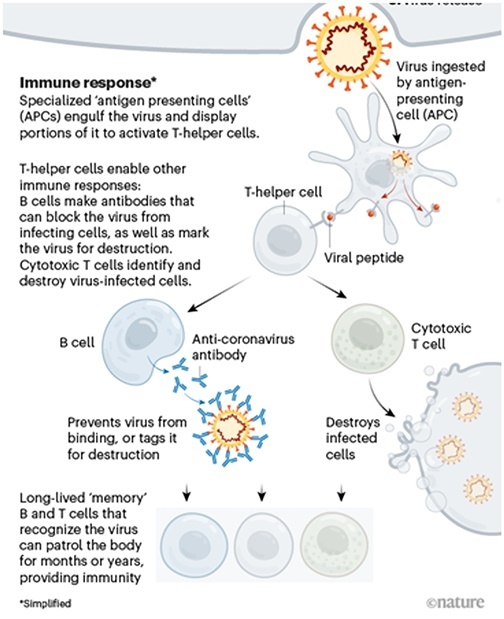
In “Our Immune System” article we briefly alluded to the stimulating effect of helper cells, which signal specific B cells to produce antibodies to neutralize an intruder, and T killer cells to destroy the intruder. Vaccines thus protect the individual against a trespassing pathogen and avoids the development of the disease when encountering the intruder. The diagram above illustrates well the mechanisms involved. The dendritic cell after having internalised the virus presents a specific peptide recognized by the T helper cell which instructs B cells to multiply and fabricate zillions of antibodies to neutralize the viruses by surrounding them and the cytotoxic T cells, CD8, known as killer cells, to multiply and mount raids against the viruses that have proliferated in the body. This is how a good vaccine should work.
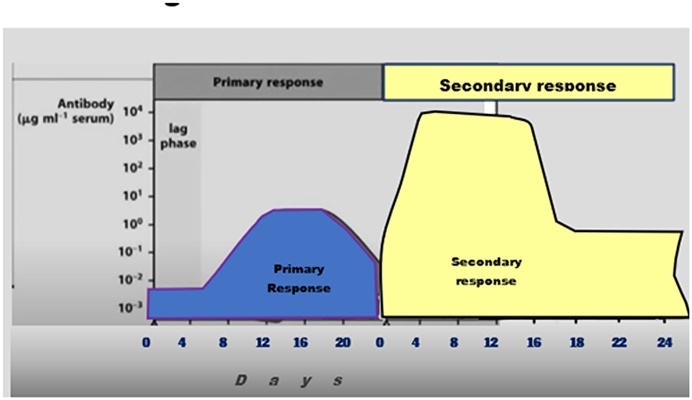
The first diagram above is a short representation of the relative production of antigens when our body is attacked by a pathogen for the first time. There is primary response initially from the innate system and then by the adaptive system that meets the antigen for the first time that lasts about 20 days.
The first diagram above is a short representation of the relative production of antibodies when our body is attacked by a pathogen on two different occasions some several months apart. During the first infection represented in blue, on about day 7 after the initial attack, the adaptive system starts operating. To fight the infection, B cells multiply and start producing antibodies in much larger quantities. As the infection is smothered, the number of antibodies in the plasma serum is reduced but to an amount 100 times greater than what was available initially, which indicates that there are many more specific B cells available to react should the same pathogen intrude at a later period.
When the second attack (in yellow) occurs some months or years later, the pathogen identified by a dendritic cell which travels to the nearest lymph node very shortly (after one day maximum), enters in contact with the helper cell that sends signals to the B cells to start multiplying. Not only are the antibodies present at the time of the second attack in much larger number than at the time of the first one, but as the B cells multiply, the amount of antibodies becomes much higher (5-10,000 more), and the infection is eliminated sooner. This the beauty of the adaptive immune system. What the last diagram does not show, is that at the same time that the helper cell instructs the B cell to multiply and produce specific antibodies, it also instructs specific killer T cells known as CD8 to also multiply and go to attack the foe.
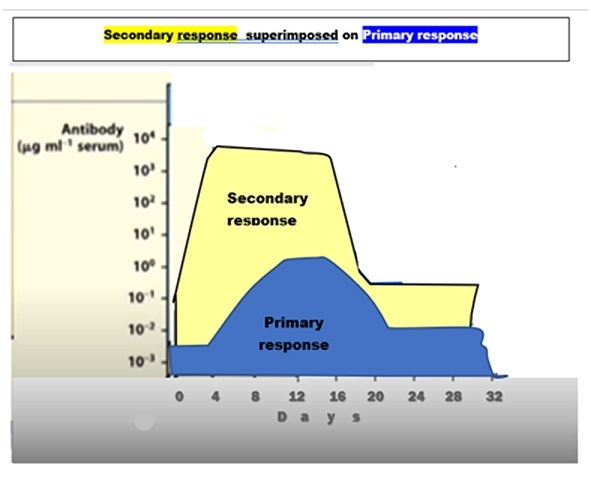
For the reader to understand better the effect of a vaccine, in the second diagram, we have superimposed the secondary response over the primary to show the differences. When a vaccine is administrated, the patient immune system reacts as if the patient was attacked but, because only a mild form of the pathogen is introduced, the patient is not sick as his adaptive immune system is now ready to react almost instantly, should he meet the actual pathogen. One can see, on the yellow curve, that the secondary response is triggered shortly (within a day) after the encounter with the pathogen and that the infection is terminated earlier than if the patient had not been vaccinated and encountered the pathogen for the first time.
What Jenner discovered by observation for a single disease and what was then scientifically invented and developed by Pasteur were vaccines. The idea behind vaccines is to mimic an attack of a pathogen by inoculating a person with a dead pathogen or an attenuated form of that pathogen to provoke a reaction of the immune system identical to that it would have generated, in case of a real attack without making one sick beyond a small reaction. It thus gives the body an opportunity to build defenses against a virus, bacteria, or a parasite it may encounter in the future.
When looking at those diagrams, it looks so simple and it is no surprise that our Doctor Strangelove believes he can have a vaccine before the end of the year, a timing that is, by surprising coincidence, is matching the date of the elections. This would enable him to claim the title of the greatest saviour of the American people. Well statistics teach us that it takes on average close to ten years to develop a vaccine and the chances are less than 10% of success. The stages involve conceptual studies, in vitro testing followed by animal testing and then human clinical trials carried in three distinct phases covering safety , efficacy, and lastly testing over a large group of several thousand patients to identify possible additional side effects not detected earlier Approval by drug authorities can take well over a year and finally then can production commence after facilities have been provided The delays are compounded as it is a very expensive and financially risky process and at each stage funds have to be found. We are here under very different circumstances, as we are facing coronavirus, the studies and trials to develop a vaccine for the SARS, MERS and Zika viruses will help to shorten the process. Moreover because of the stakes, very large pharmaceutical firms are involved at inception and authorities are eager to review results rapidly. However even the most optimist pundits talk of 12 to 18 months before a vaccine becomes available for vaccination. Even if a vaccine were to be approved within this year, it would take many more months for it to be available in sufficient quantity to carry out substantive numbers of vaccinations and several years for vaccination of the total population.
The various contenders in the quest to develop a successful COVID-2 virus have elected for different strategies or approaches to reach their goal. Many vaccines being developed will work but some will be approved before others and the rate at which they will be administered will depend on the volume of production, which is dependant on the type of approach and the ease and celerity of production. Currently there are several candidates that are being favoured by the bookmakers, in this case the financial pundits in the investment world who will indirectly finance the projects. We will review in future articles the evolution of vaccines, the prospects for the main contenders, and more in detail the intricacies of each strategy.
| By Digenis | 9 June 2020 |