







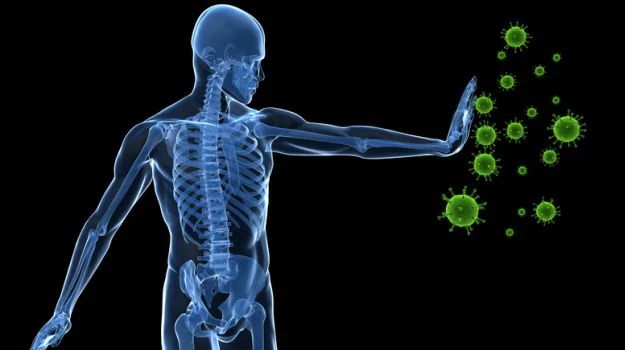
Our immune system is a series of defense mechanisms that protects us, not only against foreign malignant invaders called pathogens, but also to ensure the proper harmonization of physiological functions, such as the absorption of foods (non-malignant pathogens), non-self antigens in case of pregnancy, controlling the phases of the Immune response and maintaining self tolerance. We shall concentrate here on the defensive features of the immune system against foreign pathogens
It is supported by two distinct systems: the innate immune system and the adaptive immune system. The first is the oldest and already existed in invertebrates and progressively evolved in vertebrates as they differentiated. It can be compared to a primitive sophisticated medieval defence system with fortress walls, foot and riding soldiers, sophisticated communicating signals, boiling oil for repelling enemy and primitive artillery. Just as technology has advanced, so has the immune system. Whether from an act of god or mere evolution, a complementary system emerged on the basis that, if a pathogen had been met before, it could be judicious to have an additional special force constituted of guided missiles that could intervene more rapidly and get rid of the intruder This is what is known as the immune adaptive defense system.
A reasonable understanding of the system takes several semesters of university and as self taught amateur, I shall try to convey my primitive understanding, that should be enough for the readers to understand the jargons used in the media, and hopefully, appreciate whether they are getting an intelligent or warped interpretation. Whereas the effectives of the innate system are stationed in the various tissues or patrol on the blood vessels network, the elite corps of specialized soldiers reside in the lymphatic system either in caserns (lymph nodes , spleen, tonsils, intestinal lymphoid structure) or in factories like the thymus or the bone marrow .
THE INNATE IMMUNE SYSTEM
Although it is ancient, the innate immune system is highly complex, as it encompasses the multi-task functions of a good defense system. The most visible fortress wall is the skin that covers over 99 percent of our body surface. To protect the organs that could be attacked through the natural orifices there are other walls in the form of mucous membranes of the mouth, respiratory, gastro-intestinal, and urinary tracts. Additionally, there are bush type defenses such as cilia in the lungs, eyelashes or hairs in nose or other parts of the body to filter or limit the volume of pathogens that could penetrate the gorges off the body. These barrier defenses are not a response to infections, but they are continuously working to protect against a broad range of pathogens.
As an example, to understand how the immune system works, we will succinctly examine the various mechanisms that are put in play, when our finger skin is breached by a dirty nail. When pathogens, whether bacteria, fungi or viruses breach the subcutaneous tissue layer, they are immediately identified by different corps of sentinels such as mast cells, macrophages that can engulf those foreign aggressors and intelligence sentinels, the dendritic cells whose primary function is to call, if necessary, for additional help from the adaptive system.
Immediately behind the fields of sentinels, there are networks of small blood vessels that are running through the subcutaneous tissues not only to feed the tissues, with oxygen and nutrients, but also to act as access routes for the defense forces. When the outer skin is breached, cells present in the aggressed area, in the shape of damaged epithelial skin cells, embedded dendritic cells and other smaller cells originating from various corps of circulating blood cells ( Basophils, Eosinophils), send chemical signals that dilate the blood vessels. The enlarged pores allow the transfer of battalions of small size leucocytes, ( the soldiers of white globules corps), in the varieties of Neutrophils also known as Microphages and slightly larger Monocytes that, once in the tissue, will morph into larger Macrophages (akin to a tank). Once in the tissue, the bacteria are multiplying at an alarming rate. The neutrophils and macrophages rush to neutralize the bacteria by eating them up as fast as possible. An additional weapon is the Complement that, analogous to grenades, breaches the outer layers of bacteria and make them explode. The Dendritic cells, the decoders, also eat up the pathogen and dissect it internally presenting part of it in form of a peptide that precisely identifies the enemy. They then travel to the nearest lymphatic system headquarters. This when the adaptive system is enrolled.
THE ADAPTIVE IMMUNE SYSTEM
As vertebrates became larger and moved into environments with more and different pathogens, a more sophisticated system of defense became necessary. The adaptive system started developing, using the bone marrow as a base for an additional defense arm: the lymphatic system.
In order to provide a more precise form of defense, a new approach that could react more effectively and more specifically against pathogenic enemies, called antigen emerged. It would involve the use of new cells, specialised soldiers educated to operate in conjunction with sophisticated guiding systems to search and destroy a specific foe. The enemy could be either neutralized, by encircling him with a net and left to die (this would be the humoral system throwing antibodies) or killed precisely (this would be the cell mediated immunity system).
The lymphatic system would operate in tandem with the cardiovascular system. In addition to enabling the circulation of our blood cells that perform the oxygenation of our body, it also forms the pathways for the innate system white cells. The bone arrow not only produces the red cells (Erythrocytes) and white cells (leucocytes) but is also the initial source of bone marrow lymphocytes. (cells of the lymph). Some mature in the bone marrow and become B cells (B for bone marrow) that migrate to the lymph nodes, forming the humoral arm, while others mature in the thymus and become T cells (named after Thymus) that are used in the cell mediated response. The pictures represent on the left the lymphatic network while the picture on the right illustrates the communication between the two systems.
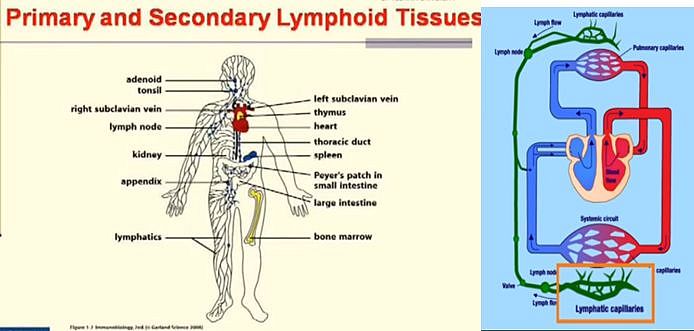
Whereas, in the innate systems the soldiers called into the war are circulating though the highway network formed by the blood vessels, the soldiers of the adaptive system have to march through the lymphatic system roads before they reach the cardiovascular highway and eventually the battlefield.
The link between the innate and adaptive system is achieved, when following infection, the dendritic cell loaded with a peptide enemy precise identity photo, is brought, after a travel of approximately one day through the lymphatic network, into a lymph node. There, it meets a lymphocyte named “T helper cell” that will, just like a sergeant at a control checkpoint, identify the pathogen and immediately issue instructions to the different sections of the barracks.
There are specific blueprints for this antigen and specific prototype for a made to measure guided rocket to bomb or kill the foreign invader. The B cells maturing into plasma cells will multiply and proceed to fabricate billions of antibodies. The helper cell will also arrange for a myriad of rockets called killer T cells to be produced and launched toward their target. They will also instruct monocytes to enter the danger zone to mature into macrophages. In addition, some of the specific Plasma cells and killer cells will be kept in reserve for an eventual future attack by the same antigen.
| By Digenis | 24th May 2020 |