



We all know the slogan of the Greek revolution “Liberty or Death”, so brilliantly immortalised by Nicholas Kazantzakis. It was the choice between a mediocre life within an enslaved land and risking one’s life to recreate a nation. It could have been the United States, it was Greece. Today, the fight is not that of few nations, against an empire, it is a fight of all nations against an enemy, whose power we have yet to properly gauge.
We are in a World War. Today it is not a war against opposed systems of governments or blocs of nations facing world domination, it is a fight of all nations against a common enemy, whose power we have yet to properly measure. It ignores nationality, religion, race, or even social status, attacking blindly with the same swiftness any unprepared individual from prime ministers to the most deprived souls. This deadly virus spreads with a celerity, similar to the one that ravaged the world over a century ago: the Spanish flue which is now known in its mildly muted form as influenza. In the absence of medication or vaccine and more substantially because of the inability to massively test the population, the solution has been , just as the case of a storm or a bombing to confine oneself in a safe place until it has passed, with the only difference of having to be separated.
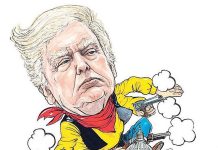
This forced reclusion is facing mounting opposition, because of the economic consequences on a severely impacted economy. This was succinctly if not tactfully expressed by the President of the United States: – “We must ask ourselves whether the cure is not more costly than the disease”. This dilemma has been politicized in the US, to such a level that one must wander whether things are not getting out of control. Inflamed by a frustrated leader’s imprecations against governors, fires of discontents fanned by mass media have forced the hands of many states to open-up, ahead of their own plans. Just when it was almost completely locked in, the Pandora’s box appears to have been opened in 31 States. It is too early to pronounce a judgement, as the effect of these decisions will only be visible in a few weeks.
The question is where the liberty of an individual stops so, as not to endanger the survival of his fellow citizen? If too many individuals become threatened, the dangerous situation can become a national or even an international crisis as we are witnessing now.
Where, in case of extreme danger, does the interest of society supersede the freedom of the individual and who judges and decides that such a danger really exists. In ancient time, at the time of city states, in periods of great danger that could threaten the survival of a city, a dictator was appointed for a limited amount of time. Theoretically, it was a great idea, but the contaminating thirst of power destroyed the medicine, by giving rise to totalitarian regimes ranging from Communism, Nazism, or plain military rule. These movements have always in the long run proven disastrous for the nations that allowed the usurpation of power by a few, that ended up conserving it through corruption. On the other hand, unbridled democracies have proven equally disastrous and have often given the opportunities for dictatorships to take foot. This difficult balancing act has given rise to what we call mature democracies, which Churchill had dubbed as the least bad form of government.
But today one must ask whether one’s liberty price is the cost of death of somebody else.
As nations we are in a period of great danger, as we risk being decimated by an enemy, we know very little about, except that it is disproportionately contagious. It is not the mortality rate itself, which is of great concern, but the sheer number of people that will be exposed if it is not stopped or at least temporarily smothered. Like the flue, it risks mutating from season to season and there are many questions as to whether it has not mutated already. At this moment, we are forced to “buy time” until either an adequate therapy is found, a reliable vaccine is created or simply the virus mutates in a mild form that we can live with. As individual nations we are free to choose the methods to accomplish our goal.
The first choice is the value of life over the denars (certain people call it dollars!) in our pockets. The has latter had a lot more traction in some countries and time will be the judge of the value of their choice. Fortunately, the vast majority of the humanity has chosen life over wallet. The notion of confinement and the benefits of social distancing have been well accepted, which proves that public has grasped the dangerousness of the foe. The problem facing the authorities in each nation is how to ensure that as the restrictions are loosened everybody abides and that sufficient means of detection of infection tracing and isolation can be effected to prevent the irruption of clusters large enough to overwhelm the health system.
As we saw in “to Test or not to Test”, Korea succeeded largely by intensive testing and social discipline of a cooperating population. In addition, normal life was preserved by rigid hygiene procedures including temperature checks, disinfecting booths, and publicly available disinfectants. Quarantined people were stringently monitored. Also, some tracking intelligence was achieved through phone applications. Similar procedures were adopted in Taiwan. In China, the monitoring and control was draconian with a system of camera surveillance with face recognition, telephone tracing applications and physical control by communist party small groups assigned to individual residential blocks.
As we progressively lift the restrictions, it is going to be revealing if we can maintain our social distancing within a public environment without rekindling the spread of the virus. Will the shops and other establishment be disciplined enough to have the proper infrastructure and police themselves the measures? To what extent will there be a government active control. The ultimate weapon of the government would of course be the reintroduction of certain preventive measures. Somehow, It feels that the success so far may very well motivate the public to follow the guidelines with minimum deception.
But can we expect when we open our frontiers the same discipline from tourists that may not have the same respect for guidance as they would have in their own countries? Do we have to restrict their freedom of movement to certain areas like the most popular islands that can be accessed directly from abroad and should we thin-off some form of electronic tracking to minimize the load on our police force or special units trained for that purpose?
We cannot keep the enemy in a semi lockdown. We must open for tourism at a calculated risk. It is, as the Economist magazine a trade-off between life, death, and the economy. If we minimize the risks, albeit for a lower overall return, we will succeed.
| By Digenis | 5th May 2020 |