








“Anatomy of a crisis” was an attempt to explain the policy of flattening the curve and also introduce a new approach, to put in perspective infection rates on national or regional basis, so as to compare objectively the severity and the stage of the local epidemic. Whereas the models try to predict the shape of the curve of serious cases to gauge whether they have enough ICU beds, ventilators, PPE, and medical staff, we have taken a more approximate method using the limited data available.
In “Lies, damn lies and statistics” we showed, how the death rate curve lags some 3 to 4 weeks the infection curve. We have today tried to compare the reported daily cases of two groups of countries, two that have taken early measures in advance of the tsunami and, two others that underestimated the contagiousness and the rapidity of spread of the virus.
In “Ransom for unpreparedness” we made a table of the timeline of the spread of the epidemic and it is evident that all countries had plenty of time to prepare for the eventual outburst of the epidemic. Korea witnessed the first infection on the 21st of January, 2 days before the US and 4 days before France and Italy. This was still in the early period of the epidemic in China that would eventually peak in mid February after drastic action from the authorities.
The value of the smoothed daily infection rate, using the moving average technique, may enable us to anticipate the peak of ICU and respirator demand as well as the fatality sequence. Although we do not have data on people under respirators, it is fair to expect that about 5-8% of the hospitalized cases undergo that crucial stage. It should therefore be possible using accurate statistics to construct models that anticipate the timing and magnitude of mortalities. This might help in very stricken regions or state to better plan the redeployment of intense care equipment to the most likely affected facilities.
Just as we did in “anatomy of a crisis” we have plotted the 3day infection rate moving average for two groups of countries, those that responded early (Korea and Greece) and the laggards (Italy and the US). The rates have been adjusted to reflect an infection rate per unit of population. It is remarkable how in each category the infection rate curves are comparable and run at the same level.
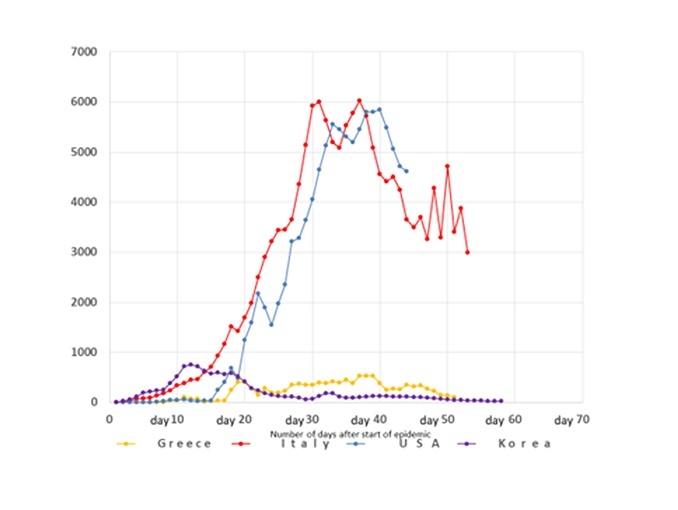
It is evident that when we adjust the rate of infection on a population basis, the countries that have taken early preventive measures have limited the magnitude of the tragedy. We shall examine the consequences of the different approaches of the two early prevention implementors and that of the other two actors’ limited abilities to react, as the infection wave arrived.
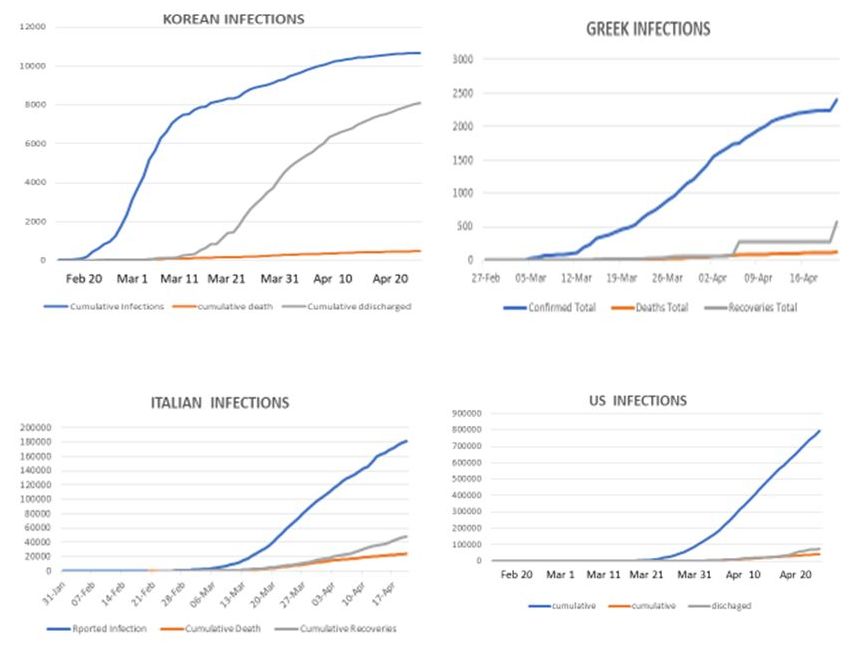
We have plotted herewith the graphs of the same four countries, which compare the cumulative infection, the cumulative death, and the cumulative discharge numbers. The Korean graph was explained in “ransom for unpreparedness”. Those charts may appear to be in too small a scale, but by displaying them all four on one page, in one glimpse, one can perceive the relative differences between the extent of the infections, but even more important, the stage in the epidemic.
Of course, the infection curve never comes down but eventually becomes flat when there are no more infections. This is showing clearly with the Korean figures where the inflection point starts around the 10th of March. Greece is showing an inflection point from the third of April. By contrast, Italy’s curve which was showing signs of beginning an inflection has shot up again, as new hot spots of infections have erupted. The US, despite the hopes generated by the recent slow down in infections in the most affected regions, does not show yet any sign of turning. The other interesting curve is that showing the number of discharged people, i.e. the individuals that have recovered. The epidemic is complete when the infection curve has become horizontal and stops extending. At that point, the blue curve of recovered cases reaches the level of the cumulative infection curve minus the cumulative ultimate death point on the mortality curve. It can be observed that the recovered curve in Korea is well advanced whereas the Greek one is just starting. One explanation could be that contrary to many other countries Greek figures include people at home and may be the statistics for those people is not yet accurately tallied.
Whatever the case, they appear to be several weeks behind Korea. Whereas the Italian first alarm occurred when it reached 12 cases on February 2nd, it would take another 16 days for a national lockdown to be introduced. In the US, 62 cases were reached on the 29th of February and the mild nationwide guidelines restricting social gathering to no more than 10 persons were issued. Here again it is 16 days after what should have been regarded as an alarm point.
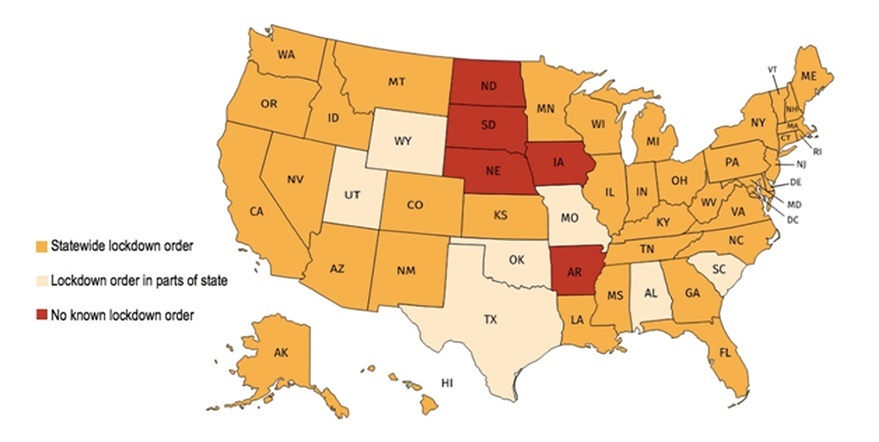
By contrast the approach of identifying hot spots, testing tracking and isolating was almost immediate in Korea while Greece, after it had reached 3 cases, in a different approach, responded within 9 days by implementing a series of progressively restrictive measures such as closing educational centers then cafes and restaurants, eventually leading to a total lockdown. It is ironically sad to see how a week of indecision can cause an exponential cascade of infections followed by massive amounts of deaths. If the case of Italy may somehow be explained by the unstable situation of the government, there can be no excuse for the most prosperous democracy in the world, endowed with one of the best collection of scientists, in failing to react early and take preventive measures. Fortunately, many of the Governors have reacted by imposing statewide lockdown.
Instead of learning the lesson from China and preparing for the challenge, the Government systematically minimised the threat, failing to alert the public and the authorities in the States. The failure to adopt the Korean strategic testing approach, that could have identified pockets of infection and lead to limited economic isolation of specific regions, has resulted in forcing an almost total lockdown of the country with much more severe economic impact. This is the economic ransom for unpreparedness.
Even worse, the failure of government to plan and build up sufficient emergency capacity for the possible peak rate of infection borders on the level of criminal negligence. This failure when hospital resources are overwhelmed will result in many unnecessary deaths. This is a human price which is unacceptable and invites an objective sanction by the people on their government in November.
| By Digenis | 22 April 2020 |