








Three friends a pastor, a social worker and an economist play golf together every weekend. One afternoon they arrive at a tee and are delayed by a player wearing sun-glasses, who keeps on missing the ball. After they quip derogatory comments the player’s partner explains the man is blind. The priest asks God’s forgiveness, the social worker thinks for sound technology to help blind people, while the economist pronounces that people like that should play at night. Does not this echo: “the cure is worse than the problem”. Even if the death toll is comparable to that of a seasonal flu it is under horrible circumstances that far exceed the expected customary loss of the elderly.
Nevertheless as the social distance standing starts to produce its effects and the epidemic starts to be smothered, one has to think about how we can restart the economy in ways that will limit the risks of detonating a second wave of the epidemic. This discussion is starting in various parts of the world and needs a lot of thought, as how to release the breaks and at what speed can we run the vehicle safely. This involves a complex decision based on many factors which are related to the amount of active carriers, not only those that we know about, but all the many others that are asymptotic and that can rapidly infect a mass of people sufficient to engender a new bout that could be so large as to overcome the hospitals emergency capacity. This is precisely the debate that is going on, in the USA, between the Governors of certain states severely affected by the pandemic and a President eager to claim his crucial role in restarting the economy, in his goal to be re-elected in November. As we write the USA has reported over 670,000 cases and by some estimates ten time as many asymptotic or unreported mild cases. This cannot be verified, as there is an abysmally low level of testing kits to carry an intensive random testing campaign. Over 25 states have already reached the 1 per 1000 infection rate and even the least affected state, Minnesota, has an infection rate of 0.35.
By comparison, the Greek reported infection rate is only 0.1977, comparable to that of South Korea 0.1955. By contrast, New York State the most afflicted State on a population basis, has comparatively over 21 times more cases than the whole of Greece. It is clear that, as we show in our article the “Price of Unpreparedness”, that both countries, as opposed to some of the worse afflicted countries such as Italy and the US that imprudently delayed preventive measures, the number of infections as well as the mortality number has been moderate. The unprepared countries witnessed a surge in severe cases that either overcame or threatened their emergency hospital capacity and also afflicted the treating personnel, many of whom died in the line of duty, due to overwork and insufficient protective equipment. We reproduce a model produced by IHME, the University of Washington’s Institute for Health Metrics and Evaluation, of possible projected infections for a specific area of Florida, the Miami Dade County.
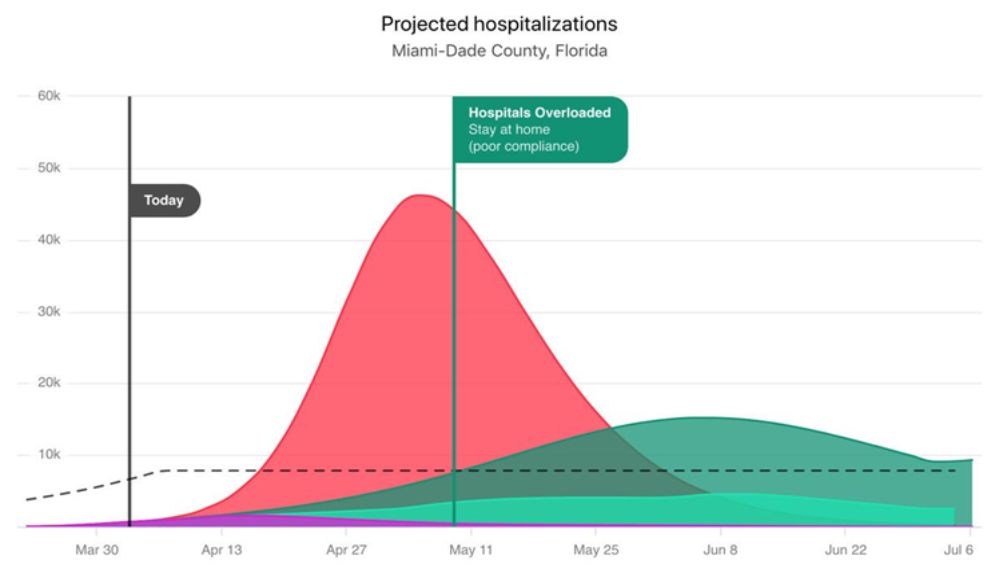
The red curve represents the expected cases without social distancing. The darker green curve represents hospital bed demand for normal demand, plus coronavirus cases, in case of poor social distancing compliance. The lighter green curve represents the total hospital bed demand under strict compliance. Even though the flattened curve apex is pushed further in time the hospital capacity becomes overwhelmed by May 11 when the social distancing is insufficiently adhered to. The dashed horizontal line represents Hospital maximum emergency capacity about 7500 beds for a population of 2.72Million. The latest figures for Miami-Dade’s hospital bed spare availability is 3,363 beds out of a total of 8,271. But these are early days in the curve. Miami Dade county reported cases were 7555 on the 14th of April, very much according to the red curve, as the Governor delayed the social distancing a few days ago, Florida being one of the last states to impose social distance standing, hence the late date of the peak.
Greece appears to have navigated the epidemic with success as even at the peak off the crisis, only 93 ICU beds were occupied by COVID-19 Patients and other patients necessitating ICU treatment were not deprived. We shall explore, given this spare emergency reserve capacity to what extent Greece can reopen the economy and the difficult decisions the task force is confronted with.
| By Digenis | 17 April 2020 |