







It took just over three quarter of a century to go from the Jenner smallpox breakthrough to Pasteur’s demonstration of the attenuation culture. Twenty years later, both at the Pasteur institute and in the US, the first inactivated vaccines were developed. Almost another three quarter of a century would pass before cell culture in vitro of viruses was developed. Shortly after, the first protein-based vaccines appeared followed by the first genetic attempts. The uncovering of the complex genome would lead to vaccine development using the expression of proteins by transcription and translation from either DNA or RNA coding for those proteins which is in rapid expansion. The chart below, published by Nature, shows the variety of approaches that are taken by different laboratories or commercial firms in an attempt to put on the market a viable vaccine against the Cov-SARS-2 virus that is causing the present pandemic. We will attempt to briefly describe these different approaches in the present article and in more detail in a subsequent one.
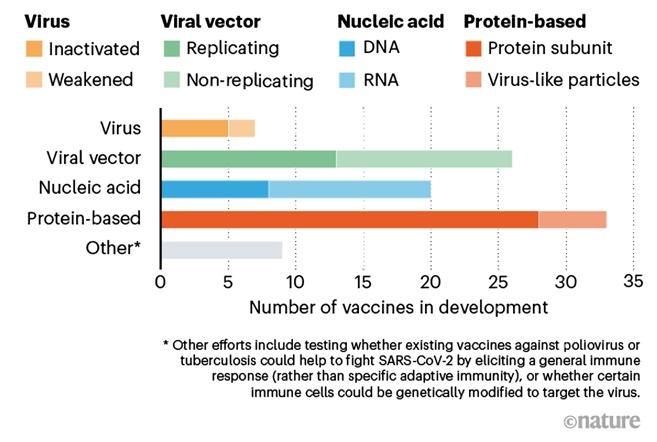
Looking at this table from Nature, it can immediately be seen that the modified virus classical approach is only pursued by a few, while the other 3 have numerous candidates. Although there had been some R&D in protein based and viral vector vaccines, the revolution in vaccine strategies was made possible by the elaboration of the human genome in 2013. This was 50 years after Watson and Crick revealed the double helical structure of DNA (Deoxyribonucleic acid). See diagram below.
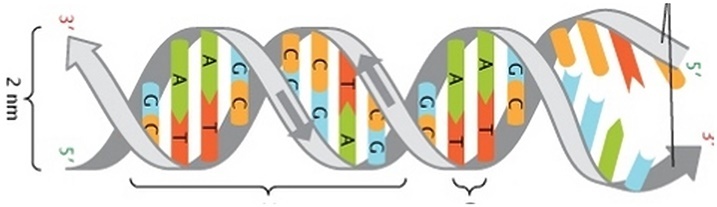
As compared to the 3 nucleotides on the above drawing, the final form of the human genome contained 2.85 billion nucleotides, with a predicted error rate of 1 event per 100,000 bases sequenced. This breakthrough was the fruit of an international, collaborative research program, whose goal was the complete mapping and understanding of all the genes of human beings. The task involved the analysis of the DNA composition of the 23 chromosomes of the human. As the number of nucleotide bases in a chromosome could vary between 50 to 250 million, it was necessary to break them into fragments. Each fragment was used to produce a collection of smaller sized segments that differed in length. The final assembly project’s draft was the mother of all puzzles. It consisted of thousands of short segments of DNA, whose order and orientation in the full genome was largely unknown. DNA clones were built and then sequenced. As their sequence sometimes overlapped, they had to be shortened to obtain a smooth continuous sequence. The project took 13 years and involved over 2800 researchers from many nations, in particular, the US and the UK plus France, Germany, China, Japan. Although there are still 341 gaps out of 147,821 gaps remaining to be found, the genome project for practical purposes was sufficiently advanced, to permit the arrival of multiple therapeutic and vaccine technologies based on DNA and RNA.
Dr Strangelove may be demonizing China, but the genome sequence of the SARS-CoV-2 was officially released by China on the 10th of January 2020 probably less than 40 days after the first case of COVID-19 in China.

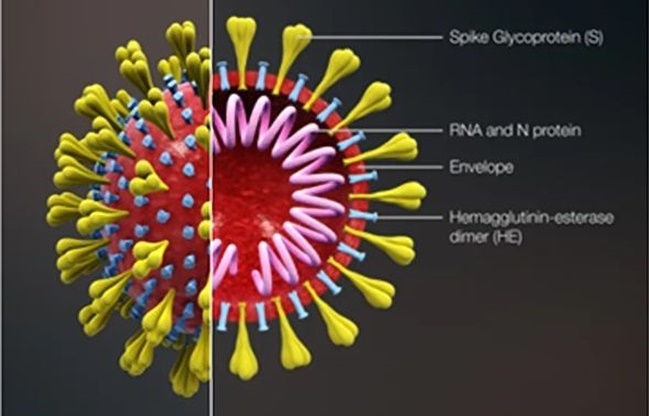
The genome of SARS-CoV-2 is 29,727 nucleotides in length, and the genome organization is similar to that of other coronaviruses. Among all structural proteins of SARS-CoV-2, S protein (in yellow on drawing) is the main antigenic component that is responsible for inducing host immune responses, neutralizing antibodies, and/or protective immunity against virus infection. The S protein has therefore been selected as an important target for vaccine and anti-viral development. Its length is only 1273 nucleotides, only a few nucleotides larger than that of the original SARS-CoV (1255 nucleotides).
Before the genome was enounced, all live-attenuated vaccines were developed using a trial-and-error based method developed in the 1880s. In the modern version the virus genome is genetically recoded with additional segments so, as to create an attenuated virus that can stimulate an immune reaction without infecting the patient. Whereas in the past, the attenuated vaccine culture into eggs was a slow and low volume process, the genetically attenuated viruses can be engineered and produced rapidly.
Other forms of vaccines whether viral vector, protein or gene vaccines are all created through genetic manipulations and therefore are designed so, as to enable fast and cost-effective production. Further, they can be quickly re-engineered in case of mutations.
Viral Vector vaccines use a friendly backbone virus carrying an antigen, virus-like particles (VLPs), or mRNAs (messenger RNA) expressing a single antigen to stimulate the immune response. These antigen appendages are also genetically formulated.
Protein-based vaccines rely on technologies that permitto vaccinate a person with a single virus component. Certain use virus like particles that contain pieces of viral proteins. They cannot cause disease because they are not actual viruses, but they can still show the immune system what coronavirus proteins look like. Others use a recombinant technology: associating viral proteins together with an adjuvant that enhances immune response
Lastly, Gene-based vaccines, a new technology that relies purely on genetics has emerged. Although technically elegant, it has yet to result in a human vaccine. Two different approaches have emerged: DNA or messenger RNA. The method is to inject into a patient, elements of a virus protein, which would induce a person’s own cells to produce minute quantities of the viral protein sufficient to trigger an immune response. DNA vaccines require injection directly into the nucleus of cells, a difficult and painful process. Messenger RNA vaccines, which consists in injecting mRNA into the cytoplasm of the cell and, relies on the same final mechanism to trigger the response, is a much easier delivery method.
The release of SARS-CoV-2 in early January was the starter’s pistol in a sprint, as who would be first with a viable vaccine. The Financial Times is partial to the mRNA breeders, and fancies Moderna Therapeutics from the US, the German stallions BioNTech RNA Pharmaceuticals patronised by Roche and Bayer AG, and CureVacAG backed by Boeringher, Johnson and Johnson and Sanofi to be some of the best favorites to the finish line. Also, in strong contention, are the viral vector technology fillies with Oxford University and CanSino technologies. Lastly the tip of Koumoundouros, without any certainty, would be the young mare Codagenix, with its very technological approach to the live attenuated vaccine line. It is going to be at least six to nine months before the finish line. Even there, the winner might be disqualified, if it is shown that he could run but not deliver an effective vaccine. We shall revisit in more detail the pros and cons of the various technologies, but also most important what kind of therapeutics may work should an effective not arrive before a second wave of the virus.
| By Digenis | 13 June 2020 |